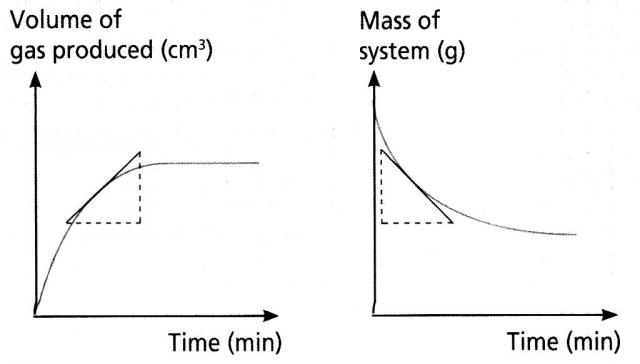
- Explain the meaning of data given in g/s, g/min, cm3/s or cm3/min with regard to reaction rate
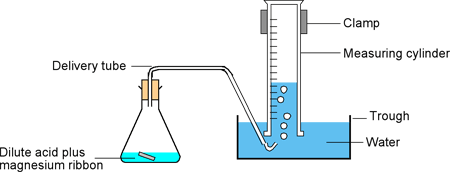
- Gather and plot reaction rate data using volumes, mass loss or reaction times
- Explain why reaction stops in terms of limiting reactant (including the idea of proportionality)
Showing posts with label C3: Chemical Economics. Show all posts
Showing posts with label C3: Chemical Economics. Show all posts
Tuesday, 8 January 2013
C3a - Rate of Reaction 1
You need to be able to:



Monday, 7 January 2013
C3b - Rate of Reaction 2
You need to be able to:
- Explain how collision frequency and collision energy effects the rate of reaction
- Explain in terms of particle collisions the changes in rate when pressure, concentration or temperature is altered
- Draw sketch graphs for these reactions (x axis is effect varied, y axis is reaction rate)
Sunday, 6 January 2013
C3c - Rate of Reaction 3
You need to be able to:
- Explain the action of catalysts in chemical reactions (change in rate, unchanged, small amount required, specificity
- Explain in terms of collisions how altering particle size can alter reaction rate
- Explain how powder explosions can occur
- Catalysts and rate notes from Chemguide


Saturday, 5 January 2013
C3d - Reacting Masses
You need to be able to:
- Use RFM and a symbol equation to show how mass is conserved in a reaction
- Calculate masses of reactants or products using RFM and symbol equations
- Explain why mass is conserved in reactions
- BBC Bitesize notes (use all 4 pages)
- Lots of RMM and RFM worked examples

Friday, 4 January 2013
C3e - Percentage Yield and Atom Economy
You need to be able to:
- Recall and use equations for percentage yield and atom economy
- Calculate atom economy given a balanced symbol equation and RFM
- Explain why industrial processes aim for the highest possible percentage yield and atom economy
- How to calculate percentage yield and atom economy slides
- Bitesize notes on C3e use both pages

Thursday, 3 January 2013
C3f - Energy
You need to be able to:
- Explain why a reaction is endothermic or exothermic, based on bonding
- Describe a practical method for comparing fuels
- Use equations to calculate energy transferred, mass of water heated, temperature change and energy output
- Endothermic and exothermic notes and videos

- Experimental methods from Doc Brown
- Energy equation (Q = mcdeltaT) video

Wednesday, 2 January 2013
C3g - Batch or Continuous?
You need to be able to:
- Evaluate batch and continuous manufacturing processes
- Explain the process involved in developing, testing and manufacturing pharmaceutical drugs
- Describe how the purity of a compound can be established
- Bitesize notes on C3g
- Phases of drug testing
- Lab method for determining melting point

Tuesday, 1 January 2013
C3h - Allotropes of Carbon and Nanochemistry
You need to be able to:
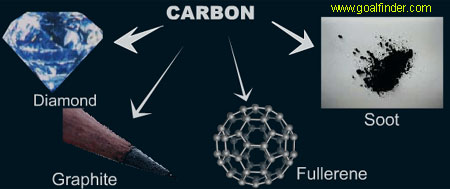
- Explain the properties of three allotropes of carbon in terms of structure and bonding
- Predict and explain the properties of substances that have giant molecular structures
- Recall and explain uses of carbon allotropes and nanotubes

Subscribe to:
Posts (Atom)